Office acoustics in Singapore
Open-plan floors, meeting rooms, and F&B or hospitality fit-outs each have a different acoustic problem to solve. We treat them as separate briefs — room acoustics, speech privacy, and mechanical noise — rather than a single blanket spec.
General information, not compliance or cost advice. Approval processes, fees, and typical pricing described here are general background — always confirm current requirements with your building management/MCST and get a site-specific quote before budgeting a real project.
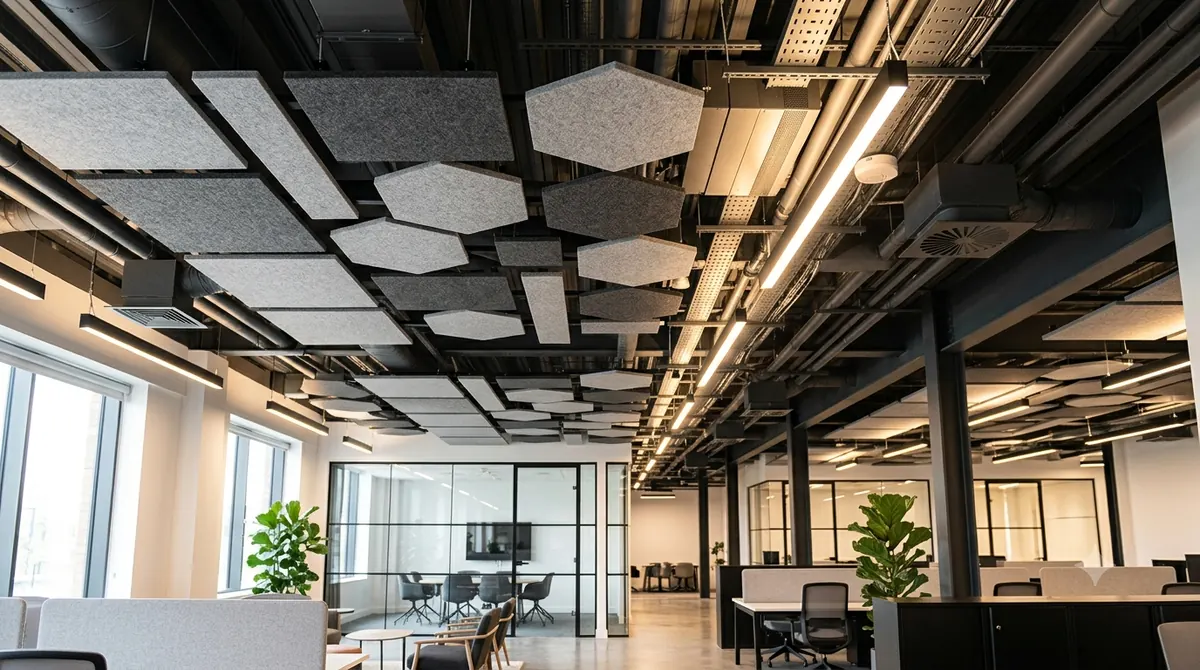 Acoustic ceiling panels — open office
Room acoustics & reverb control
Hard floors, glass partitions, and exposed concrete ceilings — the default palette of most modern Singapore offices — reflect sound rather than absorb it. As more meetings move to video calls in open-plan space, reverberation has become the single most common complaint we hear from facilities teams. We treat this with ceiling baffles, wall-mounted acoustic panels, and absorptive flooring, sized against a target Noise Reduction Coefficient (NRC) for the room's actual use — a trading floor and a quiet library zone don't need the same treatment. (We explain how NRC differs from STC, and why the distinction matters for pricing, in STC vs NRC, explained.)
BSpeech privacy & masking
Boardrooms, HR rooms, and interview spaces need sound to stay inside the room, not just sound to be pleasant inside it — a different metric, Sound Transmission Class (STC), and a different construction response: denser partitions, acoustic door seals, and in some cases active sound masking to raise the ambient noise floor just enough to make adjacent speech unintelligible without making the space feel noisy.
CMechanical noise reduction & isolation
AHU units, plant rooms, and rooftop chillers are frequently the actual source of a "noisy office" complaint that gets misdiagnosed as a room-acoustics problem. We isolate mechanical noise at the source — vibration mounts, duct silencers, enclosure panels — before specifying anything inside the occupied space, since treating the room without addressing the mechanical source rarely resolves the complaint.
Typical scope: a site survey and baseline reading, a target NRC or STC set per room based on its use, then a materials and installation plan sequenced around your tenancy's after-hours access and MCST or building-management approval requirements.
Frequently asked
How much does office acoustic treatment cost in Singapore?
It depends on the existing base build, the acoustic rating required, and installation constraints more than on floor area alone — see our full breakdown in What actually drives the cost of office soundproofing.
What NRC rating should an open-plan office target?
It depends on room use and occupant density, which is why we take a baseline reverberation reading before recommending a target rather than quoting a generic figure.
Do I need building management or MCST approval for acoustic works?
Most commercial buildings in Singapore require sign-off for anything affecting ceilings, partitions, or after-hours access — we factor this into project sequencing from the first site visit.